
DC Parking Enforcement: 1980s Fieldcraft
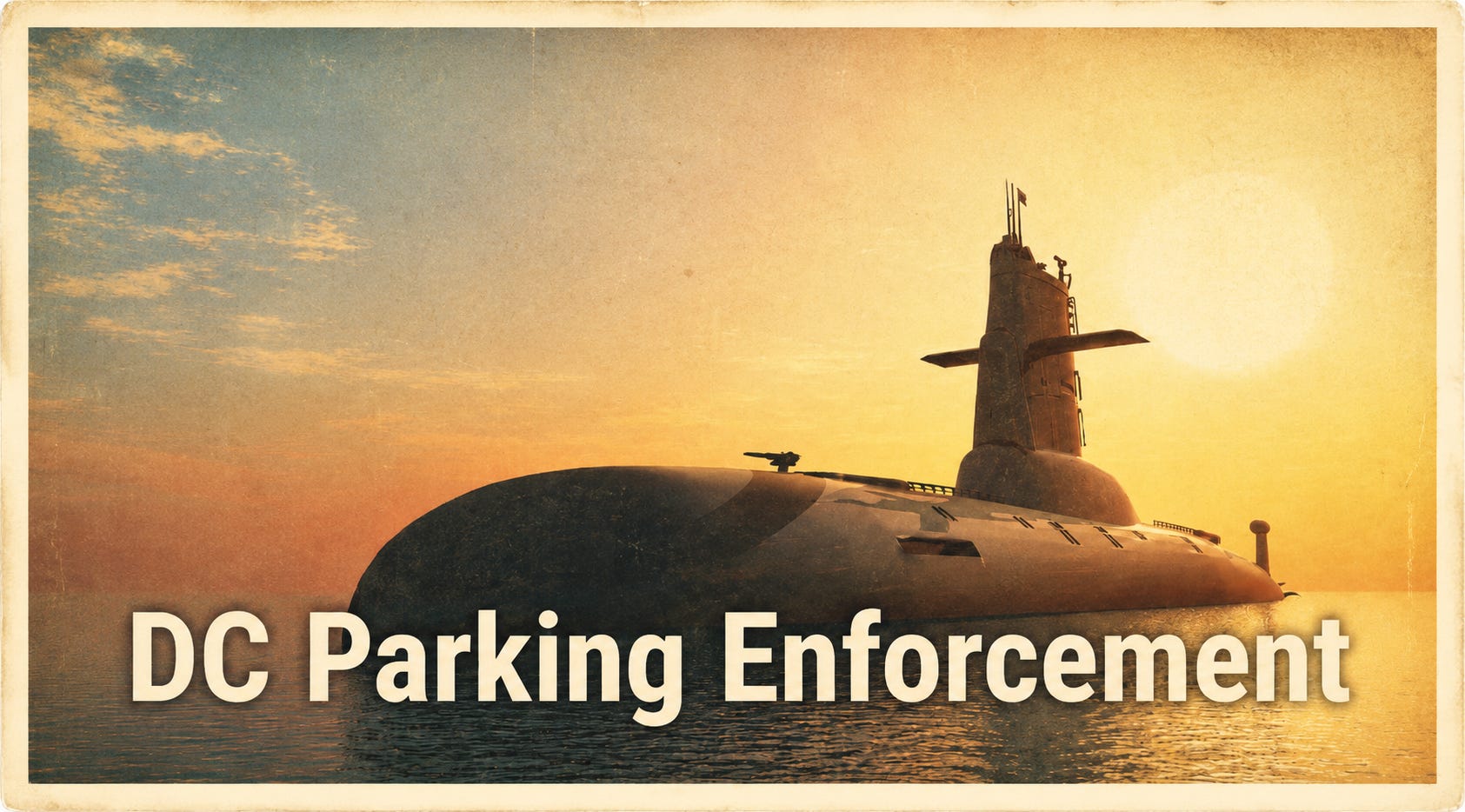
The boot trucks were like prowler subs.
The Process Server Chronicles publishes at 6:07 pm on Sundays, effective today.

Listen on Spotify or Apple or Amazon
Multiple Dates/Multiple Cases
Washington, DC
Following a vehicle within the District of Columbia could be tricky. There are the usual considerations: keeping the subject vehicle in sight at all times without being “made”, keeping up at intersections with the yellow and red lights, getting snarled in heavy traffic. And those are just a few of the uncontrollable variables of mobile surveillance.
Another variable was parking. Especially downtown, Georgetown, or anywhere near the Capitol, to name a couple examples. Parking was always at a premium, even for the persons you were following.
The bad news was the subject could sometimes circle a block multiple times, slowly. They’d be starting and stopping and looking to fit their fourteen foot long cars into fifteen foot long spaces.
The good news was they were almost always so engrossed in finding a spot that they wouldn’t even notice me right behind them, just another car in the inevitable traffic jam.
Then, the magic would happen for the subject’s car. A space would appear; they’d work their way in and I’d be left dangling.
I didn’t want to be identified. I also didn’t want to lose them.
Now what?
In one particular case, I simply drove up another six or eight cars and stopped in the lane, put on my flashers and exited the car. I caught a glimpse of the subject and the unidentified brunette as they entered a prestigious hotel just off Connecticut Ave, NW.
To know where they were going inside the hotel my choice was to end the surveillance or leave my car alone, flashers flashing in the middle of a DC street, and enter the hotel.
I chose the latter. I was able to ride the elevator with the subjects, and follow them to their room, offering friendly greetings along the way. When I saw the door they were entering I just kept walking, went down the emergency stairs and back down to my car.
Approaching my car I greeted the parking enforcement officer, waited for her to finish writing the ticket and then accepted it. After pulling my car around the block I got on my company issued radio and called the other investigator assigned to this high profile follow.
I gave him the room number.
Then, because I was now known to the subjects, I returned to the office while the other investigator stayed on the surveillance. My job was finished on this case.
Except for the paperwork.
Days Later
“I don’t know where my front license plate is,” I said.
The woman behind the counter at the Maryland Motor Vehicle Administration in Gaithersburg, Maryland gave me a look. I’m pretty sure she had heard this before. Maybe even from me. “You’ll need to sign this affidavit,” she said as she handed me the paper and a pen.
The truth was that I didn’t currently know the location of that license plate. I had discarded it the day before in a public trash can. So, it really could be anywhere by now.
I didn’t even bother to review the document because I had signed something similar a couple times before. Moments later, after paying $15.00 for a set of new license plates, I walked out the front door to continue with my day.
The Mundane Fieldcraft
Let’s be clear. As a private investigator I didn’t have a badge. No police powers were implied.
A badge would open doors I couldn’t. But a badge also had rules I didn’t have to follow. It could work both ways.
A perfect example of this was parking in the city. No Parking or Permit Only signs permeated the city. Despite the ready availability of mass transit, cars were ubiquitous.
Therefore, the District had an entire army of parking enforcement officers that scoured the city every day. Most wrote tickets. The days would have plenty of possibilities.
Then there were the parking enforcement trucks that carried wheel boots. They reminded me of submarines that prowled the ocean’s depths on constant watch for the dangers to our national interests.
Yes, parking in Washington, DC was equal in importance to the national interests of our country. Or so it seemed based on the amount of resources committed to enforcement.
In a No Parking zone it was not unusual to see a car with diplomatic plates. Or a police car from one of the many jurisdictions that patrol DC. Or undercover police cars, of which everyone knew how to identify. They parked in No Parking zones without fear of reprisal.
Me? Nobody cared about what I was doing.
Private investigators serving subpoenas or waiting on a surveillance or picking up legal documents didn’t warrant any special treatment by the parking cops. Just as I would not be given any leeway by the real police if I rolled through a stop sign or eased through a red light, carefully, to keep up with a subject.
The loophole?
Keep in mind I worked the streets of DC in the 1980s and early 1990s. Computers were still working their way into our everyday, useful lives. If you got a parking ticket, you went into a database until it was paid. That database must have been updated and distributed daily.
It was an open secret amongst messenger couriers and private eyes that you could accumulate up to three tickets before being placed on the “boot” list.
Once the prowler submarines trucks had you on their list, a parking boot was an unwelcome possibility. These boots would wrap around one of the wheels of your car, immobilizing the vehicle. You weren’t going anywhere until you paid the ticket down at traffic and then hoofed it up to the impound lot where your car would be waiting.
This happened to me once, but that’s another story.
Here’s the thing: Maryland and Washington, DC didn’t have parking reciprocity. If you were a Maryland resident, once you had three parking tickets on your current license plate, at a fine of $35 each, you could simply work the time into your schedule to visit the Maryland MVA.
Unless you’ve lived or work in cities like Washington, DC or New York, this may seem rude or unimaginable. Live, work and drive in those cities and you realize it’s just a part of the day.
Want to discuss the ethics of this or get insider views of the life of a process server and private investigator? Join me over at Behavioral Detective HQ.

Author’s Update
I’m pretty proud and I’d like to share that I finished writing my first book. It’s a novella titled Notice of Assignment. It’s now been sent off to my editor and will be released this fall.
Someone who has read it said this.
“If anyone asks, tell them it's a hardboiled novel with a noir ending and a Christian epilogue.”
That seems like a mouthful. But oddly enough, I think it is spot-on. It involves real estate, Washington, DC and Kansas City with Cal Brink as the protagonist.
To learn more, or to be added to First Alert emails about Notice of Assignment’s timelines and release, visit CalBrink.com.
Thank you.
A Chris Writes, LLC Publication
Not legal advice / not professional guidance / do not imitate tactics
Fictionalized/composite/altered details + no identification intended
© 2026 Chris Writes, LLC. All Rights Reserved.